
One-off services, a representative or your own company in China: what to choose when a project runs for months

While tasks in China are rare and separate, one-off services are enough. When a project runs for months and the factory has questions every week, a dedicated representative fits better. Your own company makes sense once you have permanent operations in China with your own staff. Below: how to tell which stage you are at, how to judge a representative's work and what to put in the contract.
The question goes out in the evening, the answer comes a day later
Picture a complex order: a factory is building a production line for you. Your engineer writes in the morning, your time, with a question about the tolerance on one part. In China the working day is almost over, so the factory answers tomorrow. The answer raises a new question. That one also goes out late and also waits a day. Each round looks minor. Over several months the rounds add up to a real delay.
This is an example, not a particular client. But it is the same problem we saw in one of our projects, described below.
Nobody here is working badly. Working hours simply do not overlap, and a complex order needs quick answers while the factory is open. There are three ways to deal with it.
Three ways to work with China
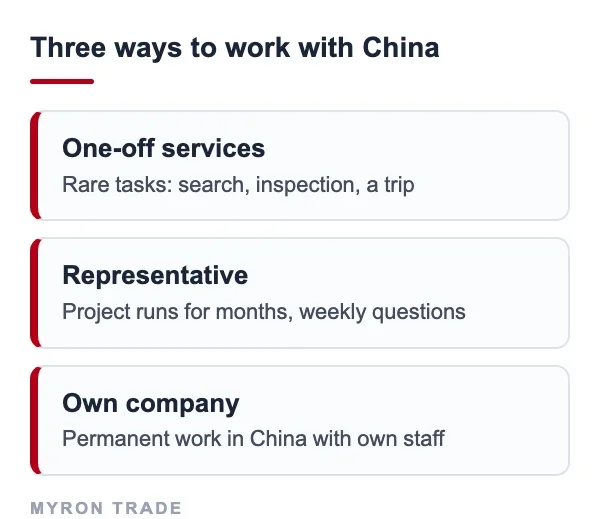
The first is one-off services. You order a single task: find a factory, check it, go to negotiations, visit a trade fair. The contractor does the job and leaves. For rare tasks this is a sensible choice, because you pay only for what you need. The weak spot shows when tasks follow one another. Between them, questions go unanswered, and every new contractor has to learn your project from scratch.
The second is a representative. This is a dedicated MYRON TRADE manager. He or she works in China from our office, speaks Chinese and your language, and talks to your suppliers during their working hours. A representative is not an interpreter for one day and not your subsidiary. Your contract is with us, and the fee is usually monthly.
The third is your own company in China. That means a legal entity with a registered address, a corporate bank account, bookkeeping and staff. In China it is usually a wholly foreign-owned enterprise (WFOE), a company fully owned by a foreign investor. It makes sense when you have permanent operations there. Opening one just to get answers from a factory is often too expensive and too complicated.
Sometimes the best advice we give is to count the costs and conclude that you do not need a company. We wrote about this in our article on registering a company in China.
| What we compare | One-off services | Representative | Own company |
|---|---|---|---|
| Who answers the factory | The contractor, while the task lasts | A dedicated manager | Your own employees |
| What you set up | A contract for the task | A contract and an agreed role | Registration, address, bank account, bookkeeping, staff |
| How you pay | Per task | Usually monthly | Running costs of the company |
| Continuity | None between tasks | The manager follows the project all the time | Depends on your people |
| What it does not give you | Answers between tasks | A legal entity, a staff engineer, industry permits | An easy start: it takes time and budget |
Signs you have outgrown one-off trips
There is no single line. These are the signs that usually show it:
- Your project in China runs from three months to a year, and the production is complex.
- You buy equipment on a regular basis.
- You talk to several suppliers at once, all the time.
- Questions to the factory pile up, and answers arrive only the next day.
- You order the interpreter, the inspection and the trips separately, and nobody holds the full picture.
If you recognise yourself in several of these, compare a representative with one-off services.
There is a second case. You do not have one big project, but you are present on the Chinese market all the time: you go to trade fairs, look at new products, meet suppliers and hold preliminary talks. One monthly arrangement is often easier than a separate interpreter, search and trips. And if you only need a live person for a single negotiation, a one-off interpreter is enough.
What happened for one of our clients
From our practice
A client was setting up production of a complex line in China. We do not name the client or the country. The first order was expected to take about six months. Technical questions were settled slowly: by the time the client's team came online, the working day in China was ending. According to the client, the order stretched to around ten months.
For the next order of the same type, the client brought in a MYRON TRADE representative. Questions were now closed during the factory's working hours. The factory had planned eight months for this order, and it shipped, again according to the client, after about five.
These two orders cannot be compared head to head. The timings come from the client. There could be several reasons: by the second order the client and the factory may have built up shared experience, and the orders themselves may have differed. We did not compare these factors, and we do not claim the representative gave the whole gain.
Still, the difference is visible. The first time, the order came out several months later than expected. The second time, earlier. One difference we know for certain: the second time, questions did not wait for the next day.
Why a local hire is not always the answer
Many people choose the simple route and hire a local employee. I would think twice. This is my opinion, based on our work with China.
A person on the other side of the world works without constant supervision. You do not see how the day is spent or whom they meet. A conflict of interest is possible: the employee is friends with a supplier or takes a commission from them. Sometimes counterparties reward the person informally, and then the factory is chosen for the wrong reasons. Not everyone does this. But the risk is built into the setup, and it is hard to notice.
With a representative, your contract is with us. A company, not one individual, answers for the agreed service.
When does this not hold? If you already have someone you trust and can supervise, hiring may work. And if there is so much work in China that you need a whole team, your own company is justified.
How to judge a representative's work
Good work shows in facts, not in impressions. Agree on five things at the start and check them as the project goes on.
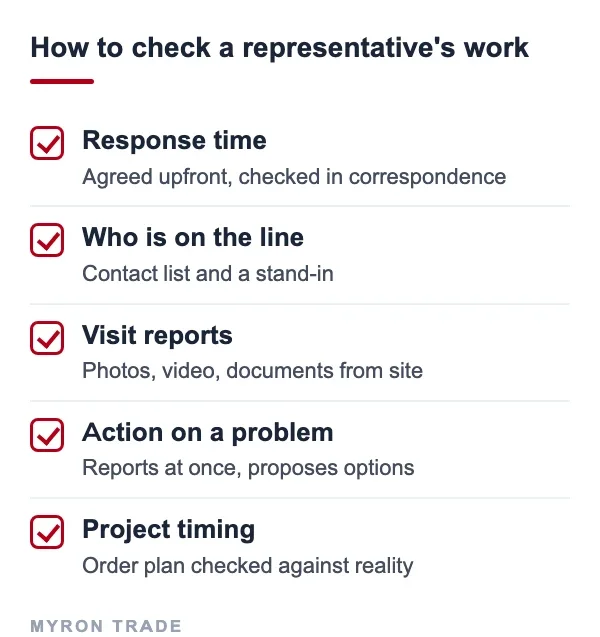
- Response time. Decide in advance how fast you get an answer to an ordinary question and to an urgent one. Check it against the correspondence, not against promises. The aim is simple: a question gets closed while the factory is working.
- Who is on the line. You should have a list: who talks to which supplier, and who answers if the manager is unavailable.
- Reports after visits. After every factory visit you get a report: what was inspected, who was spoken to, what was seen. Photos, video and documents from the site come with it.
- What happens when there is a problem. A good manager tells you at once, not at the end of the month. They say what happened, what they propose and who decides. If the issue goes beyond their role, they pass it on along a pre-agreed route.
- Project timing. Compare the order plan with reality: what is behind and why.
We do not give numeric thresholds, because they depend on the project. What matters is to write them down before work starts.
What the representative does alone and what you decide
It is better to write the limits of authority into the contract. We suggest fixing five things:
- What the manager does without being asked: passes questions to the factory, reports each side's position, watches deadlines, visits the plants.
- What only you decide: changes to the price, deadlines, specification and other contract terms.
- Payments: an approval rule agreed in advance, so that a payment goes out only after your confirmation.
- Confidentiality: drawings, prices and supplier contacts do not go to third parties.
- Language and visits: the language you work in and how often the manager goes to factories.
These are our recommendations, not a summary of a standard contract: we agree the role with each client separately. One more thing. A representative will not replace your own company in China, a staff engineer or the industry permits where they are required.
How it works with us
We start with your task: the industry, the amount of ongoing work, the language, how often you need site visits. Then we choose a manager. The manager works from the MYRON TRADE office and speaks Chinese and your language. You meet, and if it does not work out, we assign someone else where possible.
After that the manager talks to suppliers in Chinese working hours, visits factories, takes part in negotiations and trade fairs, and collects photos, video and documents. We answer for the performance under the contract. Details are on the page for representation services in China. If you are not sure you need a representative, describe your project. We will tell you honestly whether one-off services are enough.


Need help with this topic?
Describe the task in your own words — even if you are not sure which service you need. A manager will clarify the details and suggest how to proceed and what it will cost.
What happens next
- A manager clarifies the detailsin the channel you choose
- We propose a work plan and a quotewith an estimate of cost and timing
- We agree the terms and startcontract with our company in Shanghai