Human Interpreter or Translation App for Negotiations in China: Where a Phone Is Enough and Where It Is Not
A translation app copes with taxis, cafes and "how much is it". At a factory negotiation it is not enough: it translates words, while a conversation also has pauses, tone and what the other side says among themselves. Here is where you can save on an interpreter, where you cannot, and how to prepare so a person gives you the most.
Where a phone is enough
Let me be fair first: you can save on an interpreter when the stakes are low. Ordering lunch, showing a driver an address, asking a shop for a price, finding the right hall at a fair. A translation app handles all of that, and hiring a person for it makes no sense.
The line is not drawn by how hard the words are but by what a mistake costs. Say the app misunderstands a question about breakfast time. You lose five minutes. Now say you are discussing a prepayment with a factory, and one word goes wrong. That can cost you money, and sometimes the order itself.
| Task | Better choice | Why |
|---|---|---|
| Taxi, cafe, shop, navigation | App | A mistake costs five minutes |
| Asking where a hall is at a fair | App | The answer is short and easy to check |
| Talks on price, quantity, lead time | Person | One wrong word costs money |
| Factory tour with technical questions | Person | It needs industry vocabulary, and a phone gets in the way |
| Trade fair, many short conversations | Person | You must see fast who you are dealing with |
| Clinic, rental, buying a car | Person | It concerns health, a contract, money |
This is a rule of thumb, not a law. If you have worked with a factory for years and the question is simple, a message with a machine translation is often enough.
Why a phone falls short at negotiations
An app translates a sentence. A negotiation is a whole situation: what was said, how it was said and what was left unsaid.
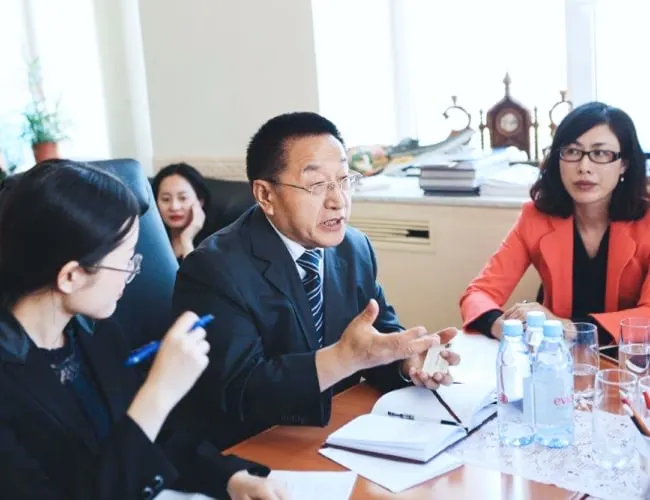
Say you ask about lead time. The other person pauses, then answers: "We will see." On a phone you get those words and nothing else. A person in the room hears the pause and the tone. It may be agreement, a polite no, or just "I need to check with the workshop". An interpreter cannot read minds, but gives you more than a line on a screen.
Next, the talk among themselves. The Chinese side may discuss your question quietly between them. An interpreter hears that and tells you when it matters. A phone hears only what you hold up to its microphone.
Then there are follow-up questions. If an answer comes out vague, an app translates the vague answer as vague. A person asks again, and you get an answer instead of a brush-off.
And your eyes. While you watch the phone and wait for the translation, you cannot see the other person's face. Their reaction to your price often says more than their words. With an interpreter you look at the person across the table.
An interpreter also tells you how meetings are usually run, which question to clarify and when it is fair to raise a discount. Our rule is simple: our interpreters have at least five years of work or life experience in China. An interpreter does not guarantee a discount. They help you decide knowing more, and the decision is yours.
What to send the interpreter before the meeting
Even a strong interpreter loses accuracy if the first time they see your specification is in the car on the way to the factory. They look for words on the move while you wait. Send the materials in advance, and they arrive prepared.
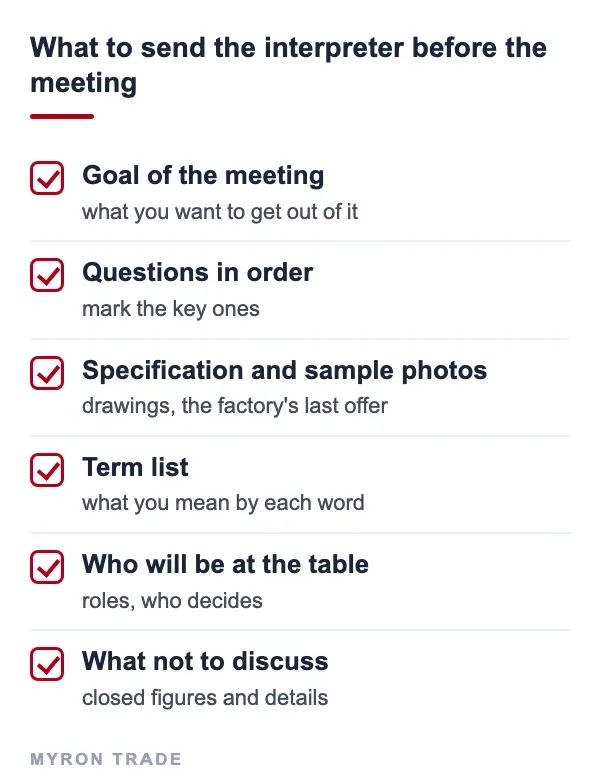
A word about the term list. Ten to twenty words are enough, the ones that mean something different in your industry than in a dictionary. Next to each, write what you mean by it.
Say "lead time" is on your list. For you it counts from sample approval, while the factory counts from prepayment. The interpreter will translate the word correctly, and you will still misunderstand each other. The same goes for a sample: paid or free, made from whose drawings. And for a price: with or without tax, and whether packing and loading are included. The interpreter knows how the word sounds in Chinese. What you put into it, only you know.
How to choose an interpreter for the task
First decide who you need at all. It is not always just an interpreter.
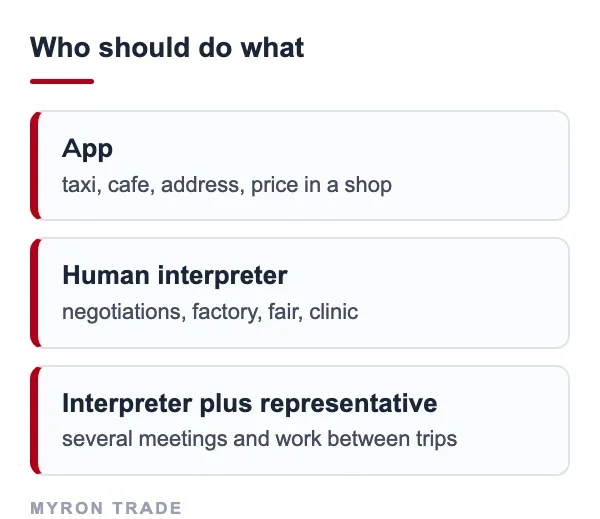
If you will have several meetings and need someone who stays on the ground between trips, look at a representative. After that it depends on where the meeting takes place.
Factory
You need someone who knows the industry's language: materials, processes, equipment. The workshop is noisy, there is no time to pull out long documents, and interpreting happens on the move. Ask in advance whether they have worked with similar production.
Trade fair
Speed and stamina matter here: dozens of short conversations at different stands in one day. The interpreter's first job is to find out quickly who you are talking to, a factory or a trading company, and whether it is worth continuing. Tell them beforehand which suppliers you are after and which three or four questions you ask each.
Clinic
The interpreter conveys the doctor's words and yours. They do not diagnose and do not replace a doctor. Health data is sensitive, so agree in advance how the interpreter handles it. If the matter is complex, check the specialist's competence separately and, if needed, their official status. Whether a clinic asks for certified documents is best found out before the visit.
Apartment rental and buying a car
At a viewing or a car inspection, the interpreter helps you put questions to the landlord or seller. The contract and its consequences are a separate matter: an interpreter is not a lawyer. Show the document to a lawyer before you sign.
What to agree when you book
To find the right person, the interpreter and the organiser need to know seven things:
- the language pair: Russian and Chinese, English and Chinese, or another;
- the city and addresses, and how many stops in a day;
- how long the work lasts: hours, a day or several days, including travel;
- transport, especially if the factory is outside the city;
- the industry: what the factory makes and which materials and processes will come up;
- the role: interpreting only, or also support in talks on price, discounts, quantities, lead times, samples and warranties;
- the report format: whether you need a record of agreements and open questions, in what form and by when.
The last point is forgotten most often. A week later each side remembers the meeting differently. A record made the same day settles the arguments.
How to run a meeting with an interpreter
Even a well-prepared interpreter has an easier job if you help. A few simple habits:
- Spend ten minutes before going in: go through the goals, the questions and the disputed words.
- Speak in short phrases, one or two thoughts at a time, and pause. A long sentence full of qualifications loses detail in any translation.
- Look at the Chinese side, not at the interpreter. They are a voice, not a participant.
- Ask for figures to be repeated, and write them down. Quantity, price, lead time and tolerance (the allowed deviation in size) are worth hearing twice. Ask for the number and the unit to be said separately.
- Agree on a signal. If you need to discuss something with the interpreter, give the signal instead of cutting in on the supplier.
- Take five minutes after the meeting: what was said about price and timing, what stayed open, which reaction looked unusual. Write it down the same day.
Leave the app in your pocket for taxis. If you switch it on "as a backup" next to the interpreter, you get two versions of one sentence, and you start arguing with the screen instead of listening to the person.
What MYRON TRADE takes on
We match an interpreter to the city, languages, industry and purpose of the meeting: a factory, a fair, a presentation, a consultation or an everyday errand. We select interpreters for experience and for how well they talk with people. About once a month the team meets to go through practical cases, and that is our regular practice. If needed, the interpreter joins in preparing the meeting and recording the outcome. Details and how to order: the translators in China service.
What an interpreter does at factories and fairs is covered in a separate article, and the trip itself in the piece on business tours to China.

Need help with this topic?
Describe the task in your own words — even if you are not sure which service you need. A manager will clarify the details and suggest how to proceed and what it will cost.
What happens next
- A manager clarifies the detailsin the channel you choose
- We propose a work plan and a quotewith an estimate of cost and timing
- We agree the terms and startcontract with our company in Shanghai