
How to sell your product in China: work out the shelf price, then go back to your factory price
Before you look for buyers in China, find out what similar products cost there and subtract everything the journey takes. If what is left does not cover your factory price and your profit, that channel is not ready for you yet. Count before the first batch, not after it. Below: the order of the calculation, the role of each channel and the story of a Russian ice cream brand we helped bring to the Chinese market.
Start from the shelf, not from the factory
Many manufacturers count like this: factory price, plus shipping, plus duty, plus a "reasonable markup". The result is called the retail price. A Chinese shopper does not have to accept it. Similar products already sit on the shelf, and their price was set by the market, not by your accounting.
So count from the other end. Say you make juice and want to sell it in convenience stores. You look at what shoppers there pay for the products next to yours, then subtract everything the other links in the chain will take.
- Find the price of similar products on the shelf of the channel you want to enter. Your price at home is not a guide.
- Subtract the taxes already inside that price and the markup of the shop or chain.
- Subtract the distributor's markup, if there is one. A distributor buys a batch from you and delivers it to shops.
- Subtract customs payments and VAT.
- Subtract logistics and storage.
- Subtract marketing: bloggers, livestreams, ads, promotions.
- Compare what is left with your factory price. Is there room for your profit?
Everything you subtract is something you will have to add back. The diagram below shows the same items in the order the goods move: from the factory to the shelf.
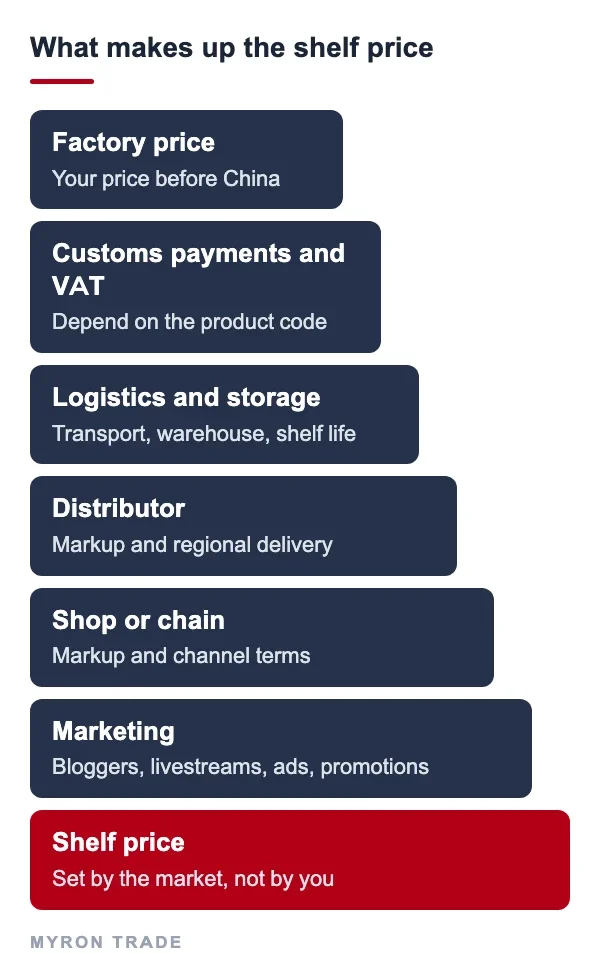
Customs payments depend on the product. As far as we know, duty and VAT are calculated from the product's code in the customs tariff (the HS code), and some categories carry extra charges. Do not borrow someone else's percentages. Check the rates for your code with a customs broker or a tax adviser.
If what is left is below your factory price plus your profit, you have three options. Change the channel. Change the product or its packaging, for example the size of one unit. Or accept that it is too early for this market. The third answer is also a result of the calculation, and it costs less than a batch stuck in a warehouse.
Run the calculation separately for each channel. The same product can earn money in one channel and lose it in another.
What each channel gives you and what to check
The channel decides which lines appear in your calculation and who does which part of the work. Terms differ by category and by partner, so the table shows only the general logic.
| Channel | What it gives you | What to check |
|---|---|---|
| Distributor | Buys the batch, stores it and delivers to shops in its region. You do not build your own supply network. | Which other brands it carries, which territories it covers, whether it will actively sell your product. |
| Chain, direct contract | Many points of sale under one contract. | Terms on price, promotions and payment dates. Who delivers to the stores. Charges on top of the markup. |
| Your own shop | The whole retail price stays with you. The shop works as a shop window for the brand. | Rent, staff, supplies. Count such a shop separately: it often builds recognition rather than profit. |
| Marketplace: Taobao, Tmall, Pinduoduo | Online sales to shoppers. Instead of a shop's markup you pay the platform. | Commission and paid services. Rules depend on the category and the trading model. Without traffic nobody sees your listing. |
We wrote about the Chinese platforms in more detail in How Foreign Brands Can Enter Chinese Marketplaces.
One channel is rarely the only one. In the ice cream story below there were several at once, and each had its own column in the calculation.
Prepare packaging and labels before the shipment leaves
The label and the documents decide whether the goods reach the shelf. As far as we know, imported goods must meet requirements on composition, labelling, certificates and sector permits. Packaging and labels also have to follow Chinese rules and suit the Chinese shopper.
Food, alcohol and non-food products go through this differently: the documents, importers, labelling and channels are not the same. There is no single scheme for all goods. Check the current rules for your category with a broker or a lawyer before shipping.
Why before the shipment? If it turns out that the composition or the name on the label must change, it is cheaper to find out before the batch is produced. Relabelling goods that have already arrived means work, storage and time, and whether it is allowed for your category depends on the rules. Food also loses shelf life while it sits in storage.
The general route into the market is described in Importing Goods into China.
When you need bloggers and livestreams
If shoppers do not know your product, the shelf will not sell it for you. That is why marketing is a separate line in the calculation, not something to look at later.
China has its own tools for this. A KOL, or key opinion leader, is a blogger whose audience trusts them. Livestream selling is a live broadcast where the product is shown and sold on the spot. There are also a website in Chinese, publications and visibility on Baidu, the Chinese search engine.
They matter most on platforms, where a listing with no visitors goes unnoticed. But a new brand offline also needs people to hear about it.
Measure the return simply. How many units sold after a broadcast or a publication, and what each one cost. If the spend does not pay back in your model, change the format or the price. Raising the budget is premature.
How it went for a Russian ice cream brand
From our practice
A Russian ice cream producer wanted to enter the Chinese market. We do not name the brand or the chain. MYRON TRADE took part in the project at different stages: importing and placing the product, negotiating with retail chains, building distribution across regions, opening branded points of sale and online promotion.
The team worked with a large convenience store chain. Flagship points opened in large shopping malls. Online, there were sales through Taobao, work with Chinese bloggers, websites, publications and brand visibility on Baidu.
The cities were Beijing, Shanghai, Hangzhou, Suzhou, Chongqing, Chengdu, Guangzhou and other territories. By our estimate, the total presence reached about five thousand points of sale across China. It is an estimate, not an audit.
Here is what matters for the calculation. One product went to market in several ways: through a chain, through regional distribution, through its own points and online. Each way has its own markup, its own delivery costs and its own role for marketing. So a project like this is counted in columns, one per route. That does not mean the same set will suit a product from another category.
Where to start
Do not send the first batch until you have walked the whole route on paper. It looks like this.
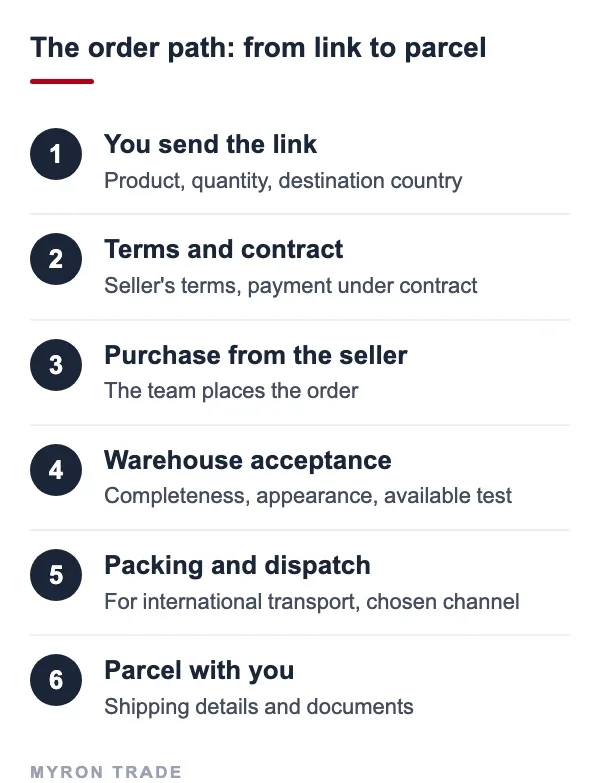
After the first sales, update the calculation with real figures. Price, packaging or channel will probably need a fix.
How MYRON TRADE can help
MYRON TRADE works as an adviser on separate stages or as an organiser from start to finish. We can assess your product for the Chinese market: import requirements, basic economics and suitable channels. After that we can prepare local packaging and labels, negotiate with importers, distributors and chains, and launch sales on platforms and marketing. How this works is described on the page Importing goods into China. Tell us what you make, and we will suggest which channel to count first.



Need help with this topic?
Describe the task in your own words — even if you are not sure which service you need. A manager will clarify the details and suggest how to proceed and what it will cost.
What happens next
- A manager clarifies the detailsin the channel you choose
- We propose a work plan and a quotewith an estimate of cost and timing
- We agree the terms and startcontract with our company in Shanghai