
Do You Need Your Own Company in China? Work Out What It Costs Every Month First
Before you ask how to register a company in China, ask whether you need one. Registration gets you a licence, not customers or profit, and the bills for keeping the company arrive every month. Our benchmark is about 1,000 USD a month. Many people who buy from Chinese factories do fine with a representative or a buying agent.
A licence is not a business
A business licence is the document that makes a company official in China. Once you hold it, the long part begins: the company has to be maintained for as long as it exists, whether you sell anything or not.
We have taken part in the registration of about a hundred companies. So our first conversation with a client is not about the name of the future company. It is about two questions: why do you need a legal entity in China, and are you ready to maintain it? Sometimes the best advice we can give is to run the numbers first. Quite often the numbers show that the company is not needed.
Our clients vary a lot: suppliers of electrical equipment, suppliers of car-wash equipment, organisers of conferences. Their business models have little in common, so there is no general yes or no. There is arithmetic for your task.
What you pay every month
Our benchmark for a working company with an office and outsourced accounting (an outside firm keeps your books) is about 1,000 USD a month, roughly 12,000 USD a year. It is not a price list. It is an estimate we use. Your own figure depends on the city, the type of business, the number of staff and how the company is set up.
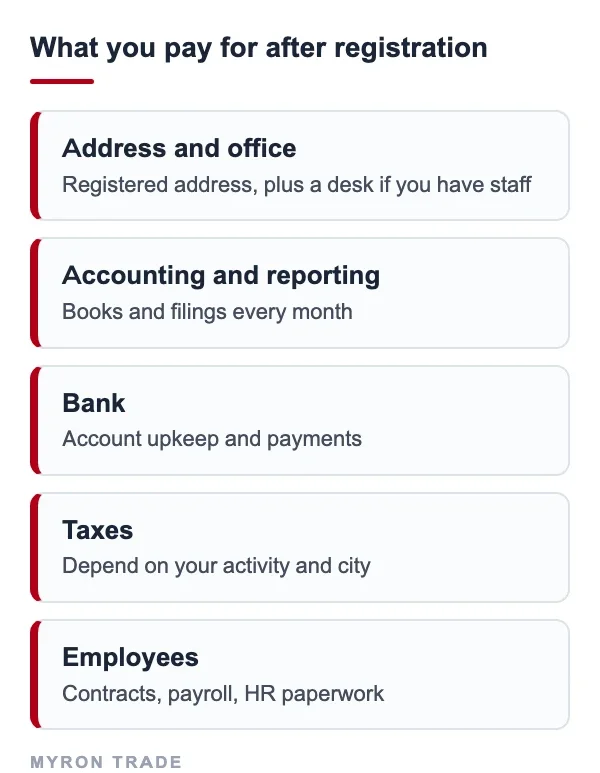
All of these costs are fixed. They do not care how much you sold this month. So compare 12,000 a year not with turnover but with the profit the China business brings you. Until that profit is bigger, the company runs at a loss.
Put accounting into the budget from month one, not "when sales start". A company exists without sales, and the bookkeeping and reporting stay with it. We wrote about how this works in our article on accounting support for companies in China.
There is also a cost you will not see in dollars. Someone on your team has to answer the bank and the accountant, sign papers and decide what to do with the company. If there is nobody for that, even a well-calculated budget will not save you.
A word on taking profit out. As far as we know, a 20% rate applies to dividend payouts (profit the company pays to its owner) from 1 September 2026. How it works in your case depends on who receives the money and from which country, so check with a tax adviser before you move any.
When a representative or buying agent is enough
If you need to buy from factories, check them and ship the goods, your own company is usually not needed. There are two lighter options.
| Option | What you get | What you take on |
|---|---|---|
| Buying agent | Buys the goods under a contract, receives, inspects, packs and ships them | A contract with the agent and the fee for the service |
| Representative in China | A dedicated manager on site: negotiations, factory visits, control | A monthly payment for the service |
| Your own company | Contracts, premises, staff and licences held in your firm's name | Address, accounting, reporting, bank and management |
Say you buy from three factories and sell the goods in your own country. You have no staff or warehouse in China and do not plan any. What would the company do? Most likely nothing, while 12,000 a year goes out regularly. This is an example to make the point, not a client story.
A company starts to make sense when:
- you need your own employees in China;
- an office or warehouse has to be held in your firm's name;
- your work needs a permit that is issued only to a legal entity;
- you plan to work in the Chinese market under your own name on a permanent basis.
If you recognise yourself in both lists, you can start with an agent or a representative and set up the company when the tasks require it. That does not always work: if the permit is needed from day one, you have to start with the company.
What can be done remotely and what cannot
Part of the work happens on paper and by correspondence. You define the goal and the structure, we choose the name and check it can be taken, and we prepare the articles of association and the founders' documents. If needed, papers are notarised and legalised in your country. Then the set is filed, the licence and seals are issued, and the company is put on tax and customs records.
Which of these steps can be done remotely, we decide for each project. Sometimes you have to be there in person. That is why we do not promise registration in a week or without a visit.
The bank works the same way. We help find a bank and support the account opening, including when citizenship, a bank's policy or extra documents get in the way. But the bank decides, and we cannot promise an account.
Find out in advance in what form you are allowed to own a business. There are three: with Chinese owners, a joint venture with a local partner, or a company wholly owned by foreigners. Foreign investment has a negative list, meaning a list of sectors with restrictions. In some sectors, approval without a local partner gets harder or the model is impossible. If you deal in regulated goods, cars or dual-use products, check the licences separately. Rely on the official rules for your activity.
Registered address, office and the place where you work
People mix these three up and pay extra because of it.
- The registered address is given at registration. It is used for documents and for contact with the authorities. In suitable projects we provide a lawful registered address for five years.
- The office is where your people physically sit. If you have no staff in China, you may not need a separate office.
- The place where you work is where you actually store, make or sell. A warehouse, a showroom or a workshop belongs here.
One address can be all three, or it can be just a line on the licence. Whether it suits your work depends on the city and the type of activity. Find this out before you sign an address service or a lease.
How to decide
Five steps you can get through in an evening with a calculator.
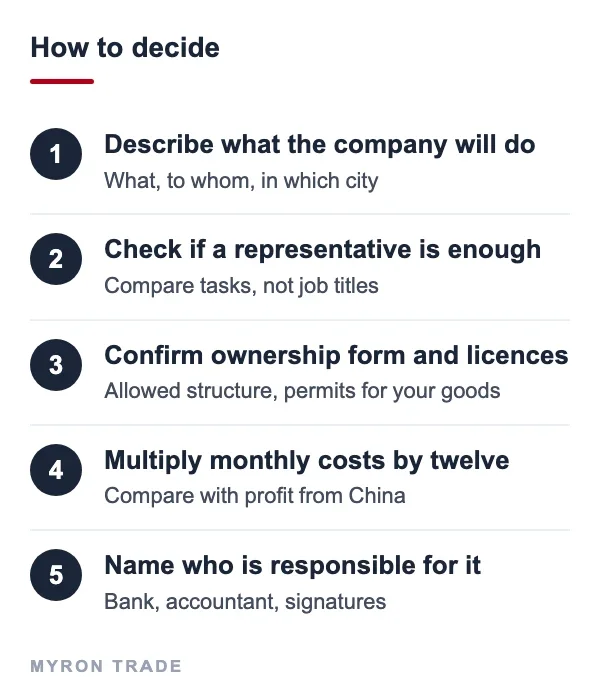
Do not skip the third step: it shows whether your model is possible at all. At the fourth, compare honestly, against your profit and not your turnover. At the fifth, check a simple thing: who will answer the emails from the accountant and the bank. If you cannot name that person, it is probably too early for a company.
If you have already decided that you need one, the procedure is covered in our guide to registering a company in China.
What we take on
We start from your task and your model: why you need a company, which structure is allowed, which permits you will need. Then we check whether you are ready for the running costs, the accounting and the reporting. If a company is needed, we prepare and support the registration, provide the address and help with the bank and the accounting. If it is not, we will suggest a buying agent or a representative. More on the page about company registration in China.


Need help with this topic?
Describe the task in your own words — even if you are not sure which service you need. A manager will clarify the details and suggest how to proceed and what it will cost.
What happens next
- A manager clarifies the detailsin the channel you choose
- We propose a work plan and a quotewith an estimate of cost and timing
- We agree the terms and startcontract with our company in Shanghai