Automechanika Shanghai 2026: sourcing auto parts in two days
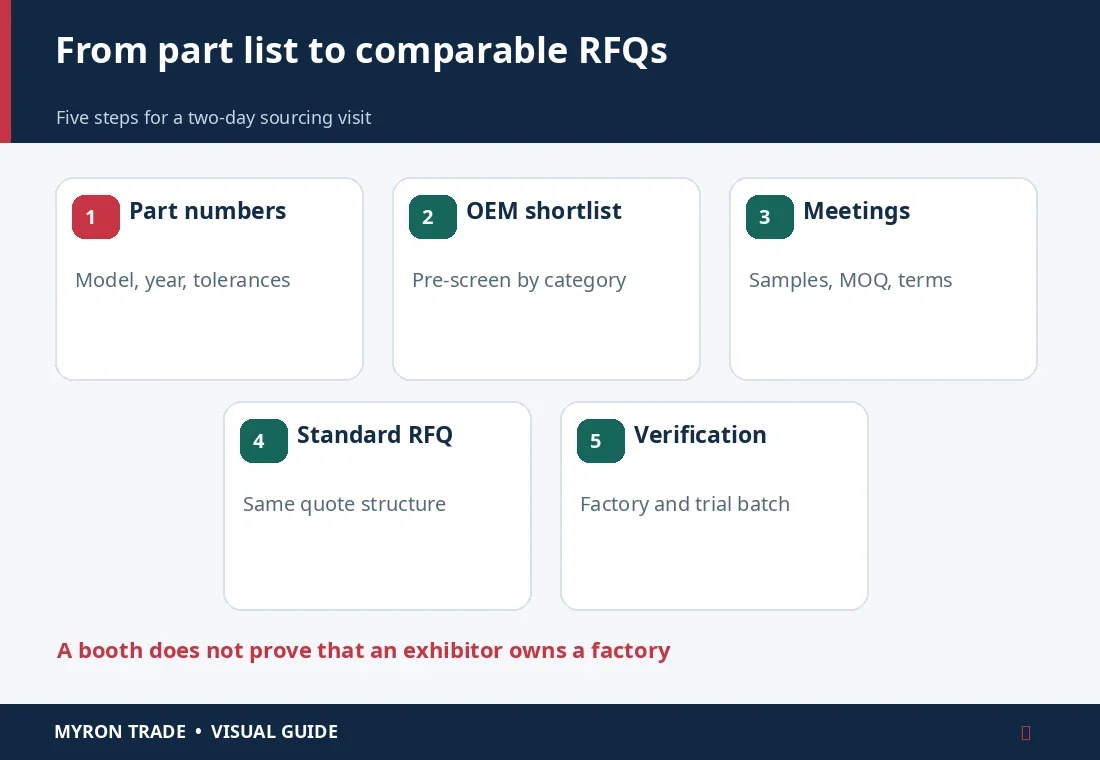
Two days at Automechanika Shanghai 2026 can leave an importer with a stack of catalogues but no clear supplier shortlist. The useful result is not the number of business cards collected. It is a list of companies whose product range, production role, minimum order quantity, samples and export conditions can be compared on the same basis.
When and where is the exhibition?
According to the organiser, the event runs 2–5 December 2026 at the National Exhibition and Convention Center (Shanghai, NECC), 333 Songze Avenue, Qingpu District. Check visitor registration and any changes on the official Automechanika Shanghai website.
The event covers multiple categories: mechanical parts, automotive electronics, EV systems, repair and diagnostic equipment, accessories, wheels and lubricants. Importers should avoid treating all products as one sourcing project: the tests, compatibility documentation and supplier qualifications for body panels are very different from those for vehicle electronics.
Prepare a precise parts brief before arriving
MYRON TRADE has built automotive contacts through years of exhibitions, factory visits, procurement and export work. Its sourcing team can cross-check known contacts with Chinese-language industry networks and new exhibitors. That history is useful, but every supplier must still be assessed against the current product specification.
| Product category | Specify before the fair | Request at the stand |
|---|---|---|
| Body parts | Vehicle model, generation, material, tolerance | Fitment catalogue, sample, packaging |
| Brake components | Kit composition and destination-market requirements | Available testing and batch traceability |
| EV electronics | Hardware/software compatibility, power parameters | Technical documents and test scope |
| Consumables | Dimensions, formulation, storage | Specification and shelf-life details |
| Workshop equipment | Power supply, functions, local service | Demonstration, manual, warranty terms |
A request such as “parts for Chinese cars” is not enough. Include part numbers, vehicle generation, trial volumes, target countries and any applicable technical requirements. A convincing booth presentation does not confirm fitment or regulatory compliance.
A workable two-day sourcing itinerary
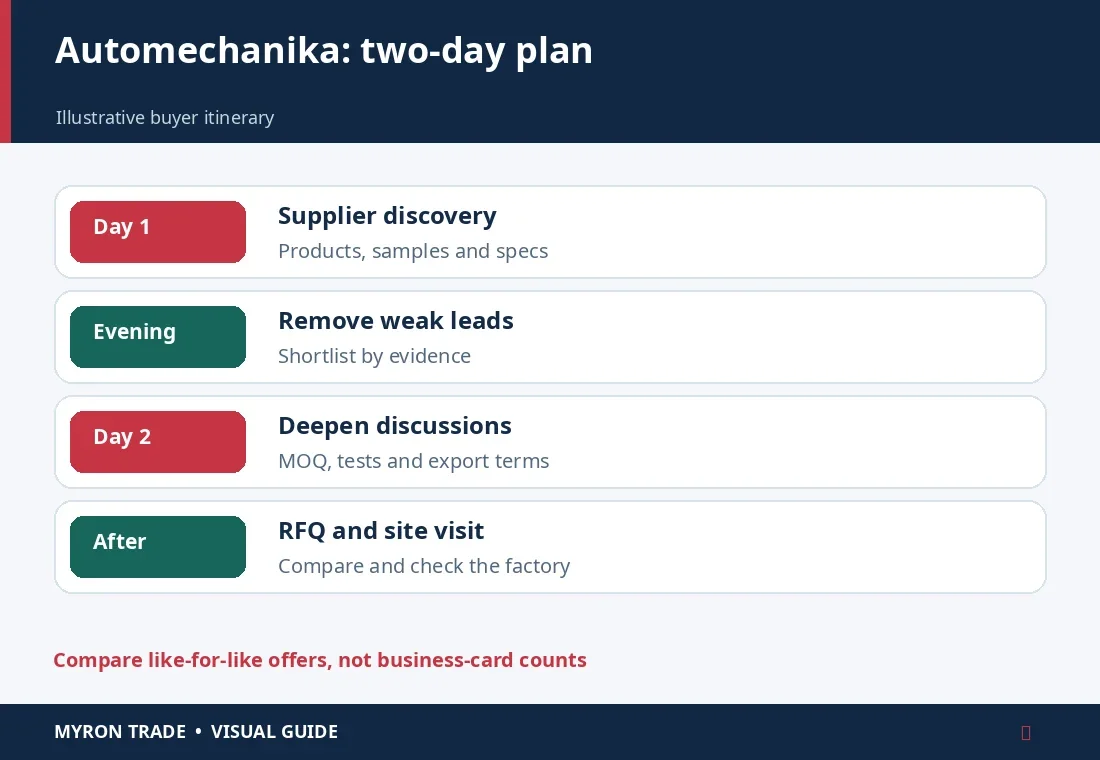
Meetings should be scheduled and prioritised in advance. This is an example programme, not a promise that a certain number of suppliers will be available.
| Time block | Day 1: discovery | Day 2: verification |
|---|---|---|
| Morning | Priority producers in selected categories | Revisit the strongest two or three prospects |
| Midday | Compare sample parts, catalogues and MOQs | Confirm specifications, tests and pricing basis |
| Afternoon | Explore alternatives and new product lines | Review documents and plan samples or factory visits |
| Evening follow-up | Remove unsuitable offers from the list | Send one standardised RFQ to remaining candidates |
By the end of the first day each promising company should have an official legal name, contact, product category, indicative MOQ, relevant specification and unresolved questions. The next day is for testing those leads, not accumulating more cards.
Factory, assembler or trading company?
An OEM label on a stand does not prove that the exhibitor owns manufacturing lines. Ask for the factory location, which operations are carried out in-house and which components are purchased elsewhere. A trading company is not inherently a poor choice and may consolidate low-volume orders, but the buyer still needs to know who is accountable for defects and replacement parts.
| Signal | Clarify | Risk if skipped |
|---|---|---|
| Booth name versus business licence | Are the seller and producer the same entity? | Payment to the wrong party |
| Samples and tooling | Who owns or controls the moulds and reference samples? | Unexpected charges and delays |
| MOQ | Does it change by material, colour or packaging? | Price assumptions that do not hold |
| Export documents | Who sells and exports the goods? | Clearance and invoicing problems |
| Quality access | Can an independent inspector visit? | Unverified production batch |
Where MYRON TRADE fits in
The team can help identify relevant exhibitors, arrange meetings, provide an interpreter and compare commercial quotations. If a supplier appears promising, the next steps are a company verification visit, samples, a quality inspection and possibly managed procurement. Each step addresses a separate risk.
A professional interpreter generally costs USD 300–350 for seven hours, plus USD 50–65 per additional hour. Transport and specialised tasks are quoted separately, and next-day availability depends on the individual specialist.
Discuss Automechanika sourcing on WhatsApp: send your part categories, target quantities, dates and preferred language. Related services: manufacturer search and interpreters.
Read also
Finding a manufacturer in China: from a product idea to a real factory
Related service: Supplier search
How to find a factory in China for a non-standard production line
Related service: Supplier search
Industrial production line in China: from engineering brief to commissioning
Related service: Supplier search
Need help with this topic?
Describe the task in your own words — even if you are not sure which service you need. A manager will clarify the details and suggest how to proceed and what it will cost.
What happens next
- A manager clarifies the detailsin the channel you choose
- We propose a work plan and a quotewith an estimate of cost and timing
- We agree the terms and startcontract with our company in Shanghai