
Buying an Industrial Line in China: How to Test Machinery Before Shipment
A Chinese equipment supplier sends pictures of a completed industrial line and requests the final payment. Before the machinery leaves China, the buyer needs answers to three different questions: Does it match the purchase specification? Does it perform under agreed test conditions? Is every component prepared for transport? A factory acceptance test (FAT) addresses the first two; a separate packing and loading inspection addresses the third.
What FAT can prove — and what it cannot
A FAT is an agreed test at the manufacturer's premises, witnessed by the buyer or authorised specialists. It is not a tour of the workshop or a five-minute video of a running motor. With complex machinery, not every module can necessarily be assembled into a complete production line at the factory. If that is the case, the parties should document which individual modules were tested and what will be verified later during site acceptance testing (SAT). The absence of full assembly is not automatically a defect, but it leaves integration risk for the buyer.
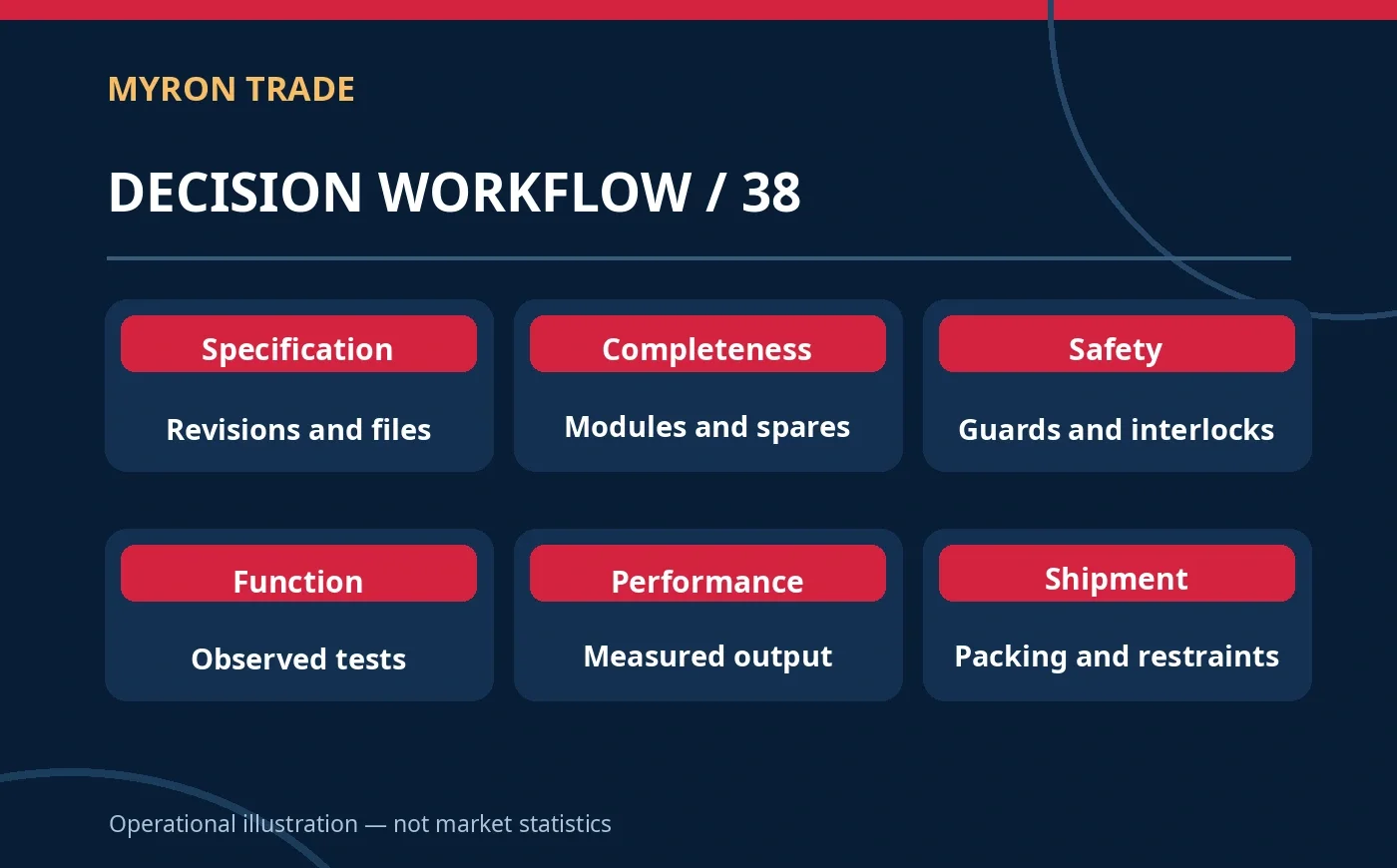
| Checkpoint | Practical test | Evidence to request |
|---|---|---|
| Contract baseline | Match installed parts to approved drawings and specifications | Revision numbers and deviation list |
| Completeness | Compare serial numbers, cabinets, motors, spares and accessories | Component register and packing list |
| Safety and wiring | Inspect agreed guarding, connections and emergency functions | Photos and recorded test results |
| Operating sequence | Demonstrate start, stop, interlocks and alarms | Continuous video and measurement log |
| Capacity | Run approved feedstock for a defined test period | Actual output and conditions |
| Shipment release | Check preservation, lifting points, packaging and restraints | Packing and loading records |
Agree the test protocol before the factory visit
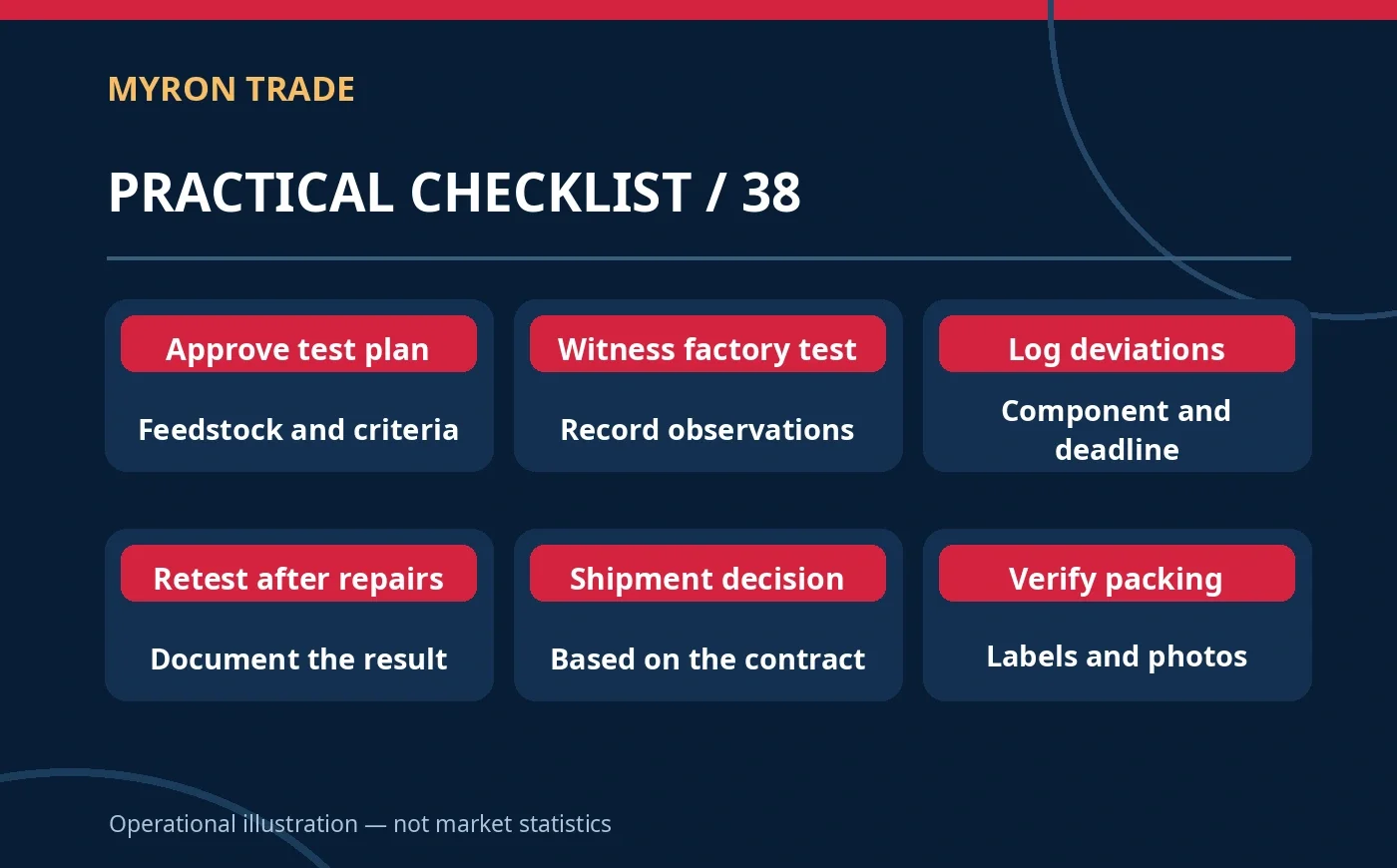
The weak question is “Does everything work?” A useful question is “At which feedstock, load, duration and measurement method do we check performance?” The protocol should define acceptable deviations and the equipment, instruments and operating conditions needed to produce reliable evidence. A visually operating machine does not establish its contractual throughput.
| FAT protocol question | What the parties must agree |
|---|---|
| What goes into the machine? | Feedstock grade, particle size, moisture and quantity |
| How is output measured? | Units, instruments, sampling and tolerances |
| How long will the test run? | Warm-up period and meaningful steady-state interval |
| How are deviations documented? | Component ID, photos, cause, owner and deadline |
| Who may sign the protocol? | Named representatives and acceptance authority |
| What happens afterwards? | Retesting, shipment approval and site test obligations |
What MYRON TRADE has actually done in complex machinery projects
In one real project, a client from Turkmenistan needed an industrial production line but had an incomplete technical drawing. MYRON TRADE involved engineering specialists, developed a more workable configuration, contacted five manufacturers of different components and organised a visit to a comparable operating installation in Kazakhstan. Later the team supported communication with Chinese factories, trial assembly and inspection, and the organisation of Chinese specialists for installation and commissioning at the buyer's site.
This is evidence of industrial project coordination, not a claim that a particular FAT throughput was measured and passed: no such measurement is documented in the supplied project notes. The lesson is that machines made by different suppliers must function as one system, which should be addressed before export.
Another confirmed project concerned procurement of equipment for cutting and recycling used tyres, worth hundreds of thousands of dollars. The MYRON TRADE team helped identify manufacturers and oversee production, machinery inspection, packing and shipping preparation. A procurement project of that scale needs traceable checks rather than an informal supplier assurance.
Three possible decisions after a FAT
| Decision | When it can be appropriate | Required record |
|---|---|---|
| Release for shipment | All contractually required tests pass | Signed results, part IDs and packing scope |
| Conditional approval | Minor, agreed deficiencies can be closed safely | Punch list, responsibility and verification deadline |
| Hold shipment | Critical tests fail or key equipment is missing | Non-conformity record and retest plan |
Where the contract allows it, the final payment milestone can be linked to satisfactory FAT results. That is a negotiation and legal question, not an automatic right to withhold payment under every contract. Review the actual agreement before issuing a formal rejection.
The documents an independent inspector needs
Provide the agreement and attachments, approved drawings, technical specification, required test results, spare-parts list, factory address, and expected completion date. Confirm whether the site has a suitable power supply and test material. A general factory inspector can check identification, packaging and basic functions; complex performance or electrical safety questions may require a qualified engineer. An interpreter helps communication but does not substitute for engineering competence.
MYRON TRADE's typical simple product inspection is approximately USD 330–350 plus transport. A multi-day technical FAT, engineer attendance and specialised instruments are scoped and priced separately. We can organise factory communication, a qualified visit, evidence collection, inspection follow-up and shipping coordination.
Questions buyers should settle before shipping
Does FAT replace commissioning? No. Integration, utilities and site operating conditions remain to be checked after installation.
Is a supplier video sufficient? It is useful supporting evidence, but not proof of a contractual performance measure without clear test conditions and machine identification.
What if the factory refuses the agreed test? Request the reason in writing, inspect the contractual provisions and determine whether an independent visit or a revised schedule is appropriate.
Send your line specification, intended test conditions and factory location. MYRON TRADE will propose the inspection scope and an individual quotation.
Related MYRON TRADE services: quality inspections · turnkey procurement.
Send the city, date, project brief and available documents. We will confirm the scope and provide an individual quote.
Need help with this topic?
Describe the task in your own words — even if you are not sure which service you need. A manager will clarify the details and suggest how to proceed and what it will cost.
What happens next
- A manager clarifies the detailsin the channel you choose
- We propose a work plan and a quotewith an estimate of cost and timing
- We agree the terms and startcontract with our company in Shanghai