
Factory, assembly workshop or trader: who you are really dealing with and what an on-site check shows
A polished Alibaba profile does not tell you who actually makes your goods. Behind the name there can be a factory, an assembly workshop or a trading company. All three can be good partners, but each answers for quality differently. Below are three stories from our work, the difference between these types, and the questions to ask a supplier before you pay a deposit.
An Alibaba profile will not tell you who is behind it
A tidy profile, photos of a workshop, a video of a production line. All of it is easy to prepare, AI included. It proves that someone can make presentations. It does not prove there are machines.
So before a deposit, we go to the supplier's address and look with our own eyes. Here are three situations from our work. We do not name the clients and leave out details that could identify them.
Three addresses, three different stories
First: it really is a factory
From our practice
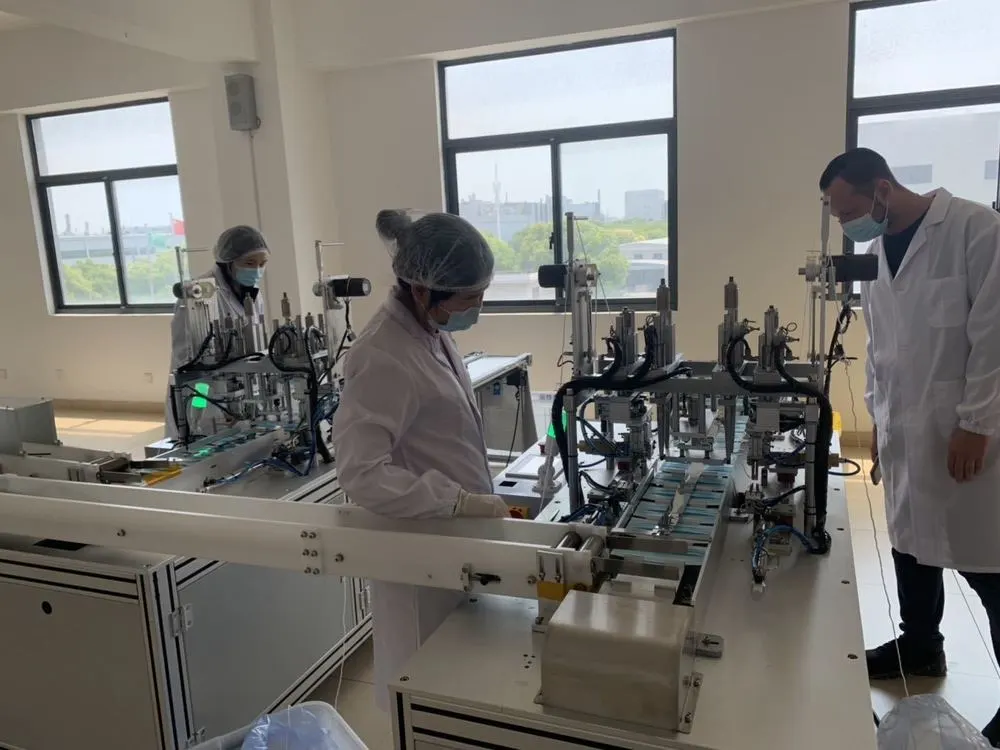
We arrive at the address and it really is a factory. The offices are busy, production is running. Then we look at what actually happens there. The factory buys its parts from other plants and only assembles and tests the finished product. It is an assembly workshop, and this is not rare.
There is nothing wrong with that. The client just needs to know what is made in-house and who answers for the parts that come from outside. We do not name the client or the client's country.
An assembly workshop is neither better nor worse than a full-cycle factory. It works differently, so the questions are different. Which parts does it buy? How does it inspect them when they arrive? If you know the answers before you pay, the arrangement can work.
Second: the production site has a different name
From our practice
The client sent us a company name. We arrived and found a different signboard and a different legal entity on the production site. We started digging. The seller the client had been writing to turned out to be an intermediary, and the goods were made by a partner factory.
It was not fraud. But the picture changed: price, responsibility and control looked different. The client was about to sign a contract with someone who did not make the goods.
Using an intermediary is not deception in itself. The arrangement works if you know about it and the contract reflects it. You need to know who answers for defects and whether you will be allowed into the factory. It goes badly when you find out after paying.
Third: an office instead of a factory
From our practice
A factory visit had been agreed in advance. We arrived and were taken to an office building. We were told production was an hour and a half away by car.
We recorded the gap between the agreement and the route in the report and asked for direct access to production.
That does not mean there is no production. It may belong to a partner. But it is a reason to get, before any prepayment, the address and legal entity of the site that really makes the goods, and to go there. If access keeps being postponed without explanation, that is a fact too, and it goes into the report.
Factory, assembly workshop and trading company: how they differ
Each story shows a different type of company. A full-cycle factory makes the product itself, in its own production areas. An assembly workshop puts the product together from parts bought from other plants. A trading company produces nothing and organises the supply.
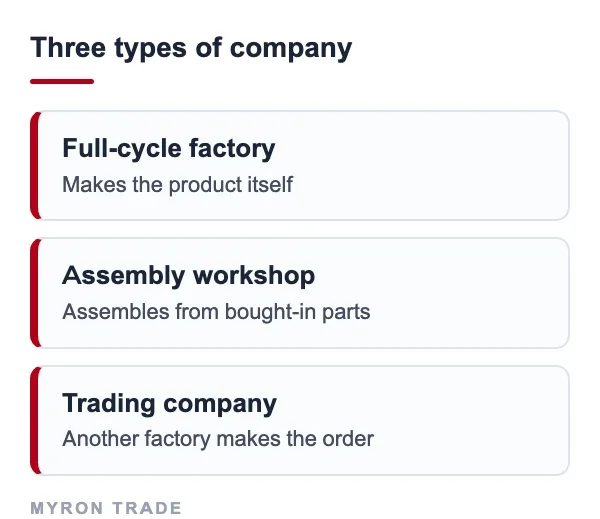
The type decides whom you go to if quality goes wrong, and what you can control yourself.
| Type | Who makes the goods | What to clarify before paying |
|---|---|---|
| Full-cycle factory | It does, in its own areas | Whether its capacity fits your order |
| Assembly workshop | Assembles from bought-in parts | Which parts it buys and how it inspects them |
| Trading company | Someone else's factory | Which factory exactly, and whether you can visit it |
A trader is not necessarily a bad partner. For a long time many factories served the domestic market, did not handle export paperwork and did not deal with foreign buyers. An intermediary connected the sides and arranged samples, staged payments and fixes. Today more factories sell directly. But for small orders an intermediary is still useful, because it pools the orders of several customers.
In our experience, a noticeable share of plants that look like factories are in fact assembly operations. So we are not hunting for "bad companies". We find out who is in front of you, and the decision stays with you.
How an on-site check works
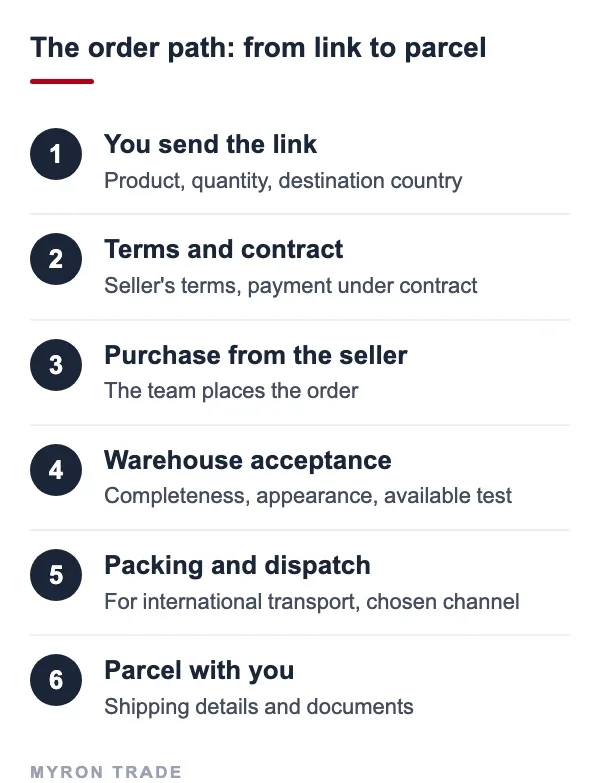
To order one, you need the company name, the address, contacts and a link to the platform where you found the supplier. What matters more is saying what you want: to confirm the company exists, to see the production, or to find out whether it can export. These are different tasks with different amounts of work. We agree the scope and payment in advance. Usually it is a prepayment, with the balance at an agreed stage, for example when the report is prepared or handed over.
Then our employee contacts the supplier, books the visit and goes. On site we record the signboard and the actual company name, the entrance, offices, people, production areas, equipment, warehouse and finished goods. We take photos and video with the host's permission. Then we establish how the business is built: does everything itself, does part, assembles from bought-in parts, or trades.
Then the documents. We ask for the business licence and other corporate papers, the legal entity's details and proof of authority for the person who will sign the contract. A business licence is the company's registration certificate, and suppliers usually send it first. It shows that such a legal entity exists. It does not show whether production runs at this address, so we compare it with the signboard and with what we saw.
The last layer is the Chinese registries. Through them we look at registration data, court disputes, enforcement, restrictions and tax risks. Each source answers its own question: photos show what stands at the address, documents show whose legal entity it is, registries show what is known about it. The most valuable part of a report is where these answers disagree.
What a check cannot do
A report gives facts, not a "reliable or not" grade. These are the limits worth knowing in advance.
- No entries in a registry does not mean no risks. The result depends on how complete and current the source is.
- A single lawsuit says little. What matters is what the dispute was about, how it ended and whether such cases repeat. It has to be read, not just counted.
- A visit shows one day. It cannot tell you what will happen to your order in six months.
- We do not promise a check of the owner's passport or ID as a standard part of the work. It depends on the situation, on whether the data is available and on whether processing personal data is lawful. If it matters to you, ask a lawyer.
That is why the visit, the documents and the registries complement each other. None of them replaces the others.
What to ask the supplier before the deposit
These are not check results, just questions that tell you a lot without one. An evasive answer is information too. Ask for answers in writing, so you can compare the words with what the report shows.
- Which legal entity will sign the contract, and to whose account will the payment go?
- What do you do on your own premises, and what do you order from other plants?
- Who answers for the quality of bought-in parts, and what happens if they are defective?
- If you are an intermediary: which factory will make my order, and can I see it before payment and at acceptance?
- Can I visit the production site itself, not an office, on an agreed day?
- Who will sign the contract, and how is their authority confirmed?
- How is payment split: how much at the start, after samples, after acceptance?
- Do you have experience with export documents?
The company name in the contract, on the signboard and in the payment details must be the same. It is the cheapest check of all. If the names differ, every other answer concerns someone you will not be paying.
What we take on
A large lost deposit can sometimes be prevented by spending a relatively small amount on a check before you pay. We contact the supplier, arrange the visit, go to the site, record what we see, request the documents and look at the registries. You get a documented report and decide yourself what to do with it. The details are on the manufacturer verification page.
The general order of a pre-payment check is covered in Verifying Manufacturers in China.


Need help with this topic?
Describe the task in your own words — even if you are not sure which service you need. A manager will clarify the details and suggest how to proceed and what it will cost.
What happens next
- A manager clarifies the detailsin the channel you choose
- We propose a work plan and a quotewith an estimate of cost and timing
- We agree the terms and startcontract with our company in Shanghai